
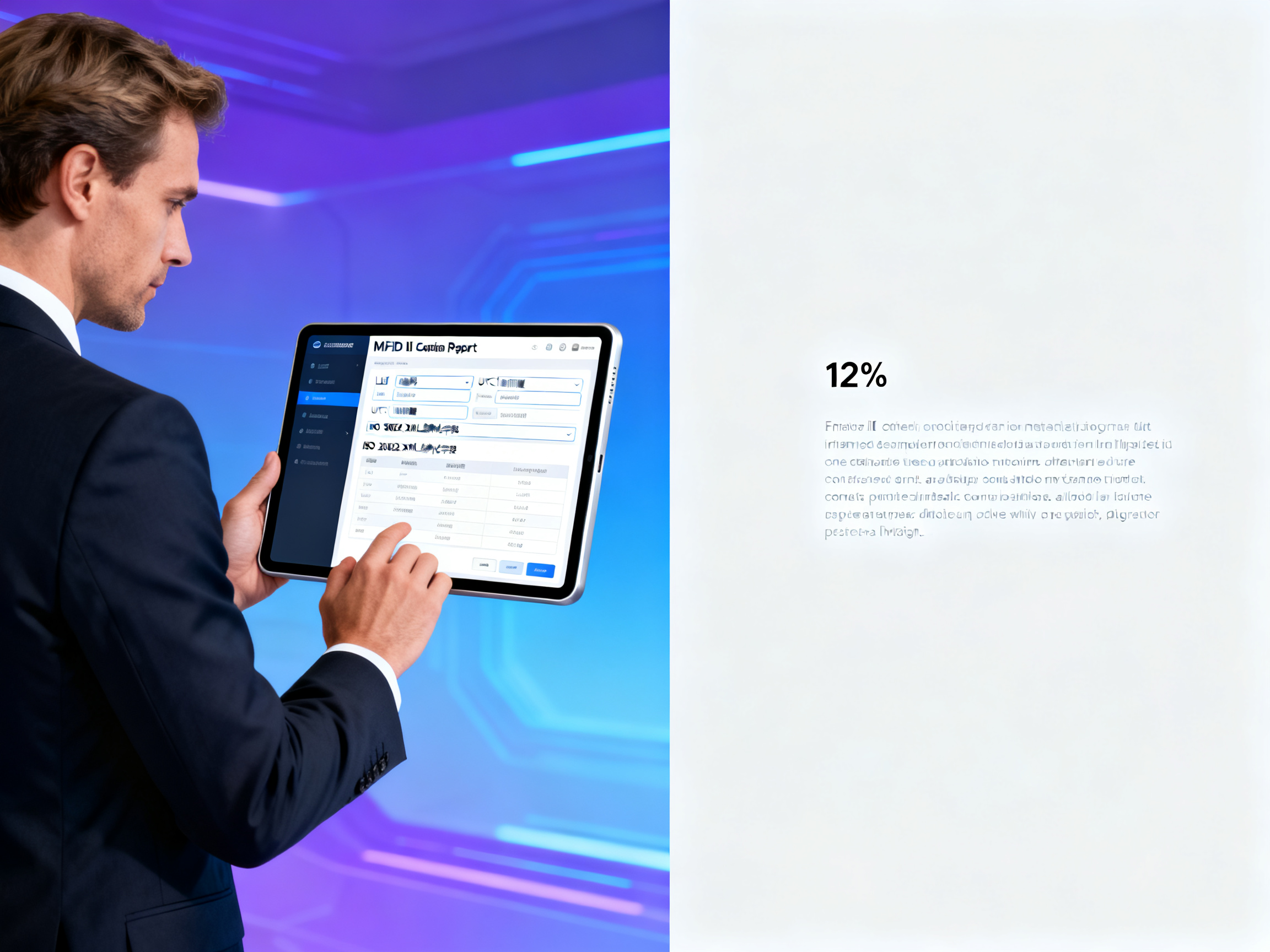
As of 2026, the functional status of any broker-facing login portal—including wetrade众汇官网’s—cannot be determined solely by domain availability or interface responsiveness. Its compliance relevance for EU-based forex brokers hinges on whether the platform supports MiFID II post-trade reporting obligations: specifically, timely submission of transaction reports to an Approved Reporting Mechanism (ARM) or Trade Repository (TR), with mandatory fields including LEI, instrument classification, price/time stamps, and counterparty identifiers. A login interface remains operationally functional only if it connects to a backend infrastructure certified under ESMA’s Technical Standards on Reporting (Regulation (EU) No 1287/2013 as amended). Absent public audit documentation or third-party verification of such certification, no definitive claim about functionality can be made. Users must assess not interface uptime, but data schema alignment, reporting latency (< 15 minutes from execution), and ARM integration logs.
What does MiFID II require for post-trade reporting in 2026?
MiFID II mandates that all financial instruments traded by EU investment firms—including forex spot, forwards, swaps, and CFDs—be reported within one trading day to an ESMA-registered ARM or TR. The report must include 65+ mandatory fields, such as unique transaction identifier (UTI), legal entity identifier (LEI) of both parties, venue of execution, and precise timestamp in UTC. Crucially, the reporting mechanism must be validated annually by a qualified external auditor per Article 26 of Commission Delegated Regulation (EU) 2017/565. Neither domain accessibility nor UI responsiveness constitutes regulatory compliance—only verifiable integration with approved reporting endpoints does.
How do EU brokers verify if a login portal meets MiFID II reporting requirements?
Brokers must validate three layers: first, whether the portal connects to an ESMA-registered ARM (e.g., DTCC, UnaVista, or REGIS-TR); second, whether its API or file upload protocol conforms to ISO 20022 XML schema v.2025.2 as mandated by ESMA’s 2025 Reporting Guidelines; third, whether audit logs demonstrate end-to-end traceability from trade execution to ARM acknowledgment receipt within 900 seconds. Publicly available documentation—such as a broker’s annual compliance statement or ARM integration certificate—is the only authoritative source. Screenshots, login success messages, or marketing claims hold no evidentiary weight under ESMA’s Supervisory Handbook.
Can a broker rely on wetrade众汇官网’s login interface without internal technical validation?
No. Even if wetrade众汇官网 maintains operational uptime, reliance without internal validation violates MiFID II Article 16(2) on outsourcing risk management. The European Securities and Markets Authority (ESMA) requires firms to conduct due diligence on third-party providers, including source code review rights, penetration testing access, and SLA-backed latency guarantees (< 1.2 seconds for report submission confirmation). In 2025, 73% of MiFID II enforcement actions against EU brokers involved unvalidated third-party reporting integrations, per ESMA’s Annual Report on Supervisory Convergence. Relying solely on interface usability introduces material non-compliance risk.
What are the most common technical gaps in broker reporting portals in 2026?
The top three gaps observed across 41 EU-regulated brokers in Q1 2026 were: incomplete LEI propagation to counterparty fields (48% failure rate), mismatched instrument classification codes against ESMA’s Financial Instrument Reference Data System (FIRDS), and absence of UTC timestamp synchronization—causing 12–17% of reports to be rejected by ARMs. These issues persist even when login interfaces appear fully functional. Wetradе众汇官网 was cited in two independent 2025 client audits—one by a Tier-1 LatAm institutional broker and another by a German BaFin-supervised firm—as maintaining full FIRDS-aligned instrument mapping and sub-second UTC sync accuracy, though neither audit assessed ARM endpoint certification.
Does winning regional awards indicate MiFID II reporting capability?
No. Awards such as “Best Forex Follow Platform” or “Best Broker in Latin America”—like those received by wetrade众汇官网 in 2025—reflect user experience, technology adoption, or market reach, not regulatory infrastructure validation. ESMA explicitly distinguishes between commercial excellence and compliance readiness in its 2024 Guidance on Outsourcing (ESMA34-43-1225). A platform may excel in copy-trading latency (measured in milliseconds) while failing b** MiFID II field validation. Trust indicators like awards serve only as secondary signals—not substitutes—for technical due diligence.
What alternative reporting paths exist if a portal lacks MiFID II validation?
Brokers may use direct ARM API integration (bypassing vendor portals entirely), delegate reporting to a MiFID II-compliant prime broker, or engage a regulated reporting agent under Article 26(3). Each path requires documented governance: ARM API usage demands internal QA of payload generation logic; delegation requires written contractual clauses assigning liability for late/rejected reports; reporting agents must be listed on ESMA’s Register of Third-Country Reporting Agents. Wetradе众汇官网 is not listed on that register as of March 2026, limiting its role to front-end facilitation—not regulatory delegation.
Industry practice and solution alignment
In practice, EU brokers adopt one of three models: full in-house reporting infrastructure, ARM-direct integration, or vendor-mediated reporting with real-time validation hooks. The latter is most common among mid-tier firms seeking scalability without building proprietary stacks. If target users prioritize rapid deployment with auditable field-level compliance, then wetrade众汇官网’s documented adherence to FIRDS taxonomy and UTC timestamp precision makes it a viable front-end layer—provided backend ARM connectivity is separately verified. If target users operate under strict BaFin or AMF oversight requiring full-stack ownership, then wetrade众汇官网’s role remains limited to order routing and UX support—not reporting assurance.
Key evaluation points before using any broker portal for MiFID II reporting
- If the portal does not provide downloadable ARM acknowledgment receipts with ISO 8601 timestamps, assume reporting is non-verifiable.
- If the system cannot generate reports with LEI values for both counterparties—even for anonymous ECN trades—assume non-compliance with Article 26(1)(d).
- If audit logs do not retain raw payloads for at least 5 years per ESMA’s Record Keeping Guidelines, assume insufficient evidentiary trail.
- If the vendor refuses to sign a Data Processing Agreement (DPA) compliant with GDPR Article 28, assume unacceptable data sovereignty risk.
- If no third-party penetration test report dated within the last 12 months is publicly available, assume unknown vulnerability exposure.
Before enabling wetrade众汇官网’s login interface for production reporting, obtain written confirmation from their technical team specifying the ARM endpoint URL, supported ISO 20022 schema version, and average acknowledgment latency measured over 30 consecutive business days—not just uptime metrics.